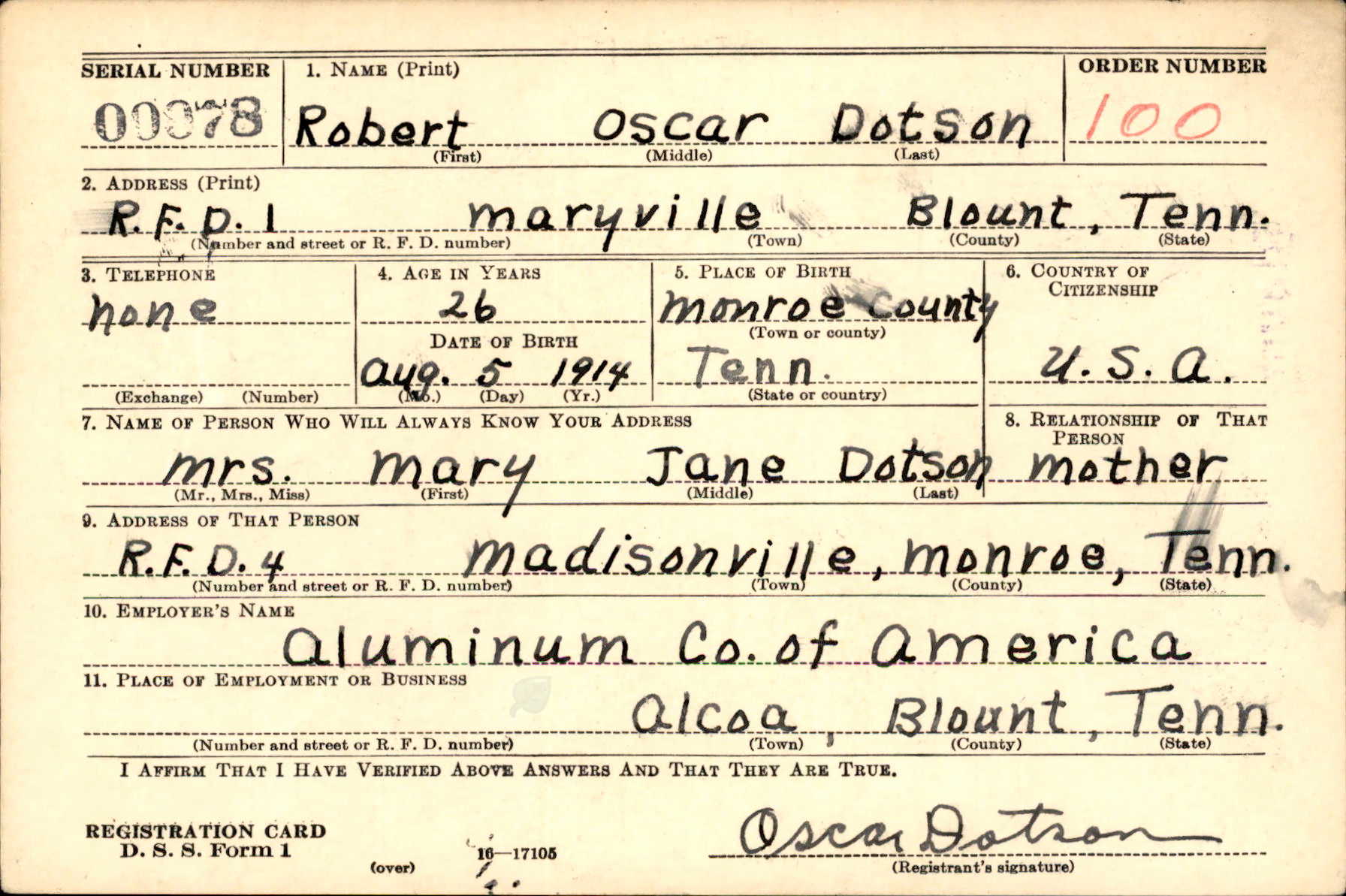
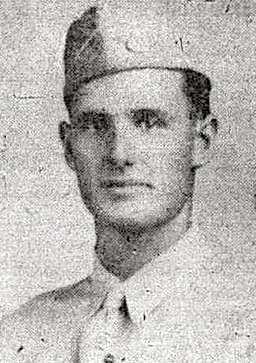
Robert Ocar Dotson was the son of Onley Robert Dotson and Mary Jane Farr. He was married to Addie Lucille Garland and was the father of Norma Esther Dotson who died at the age of 1 and Mildred Dotson.
He entered the Service From Tennessee.
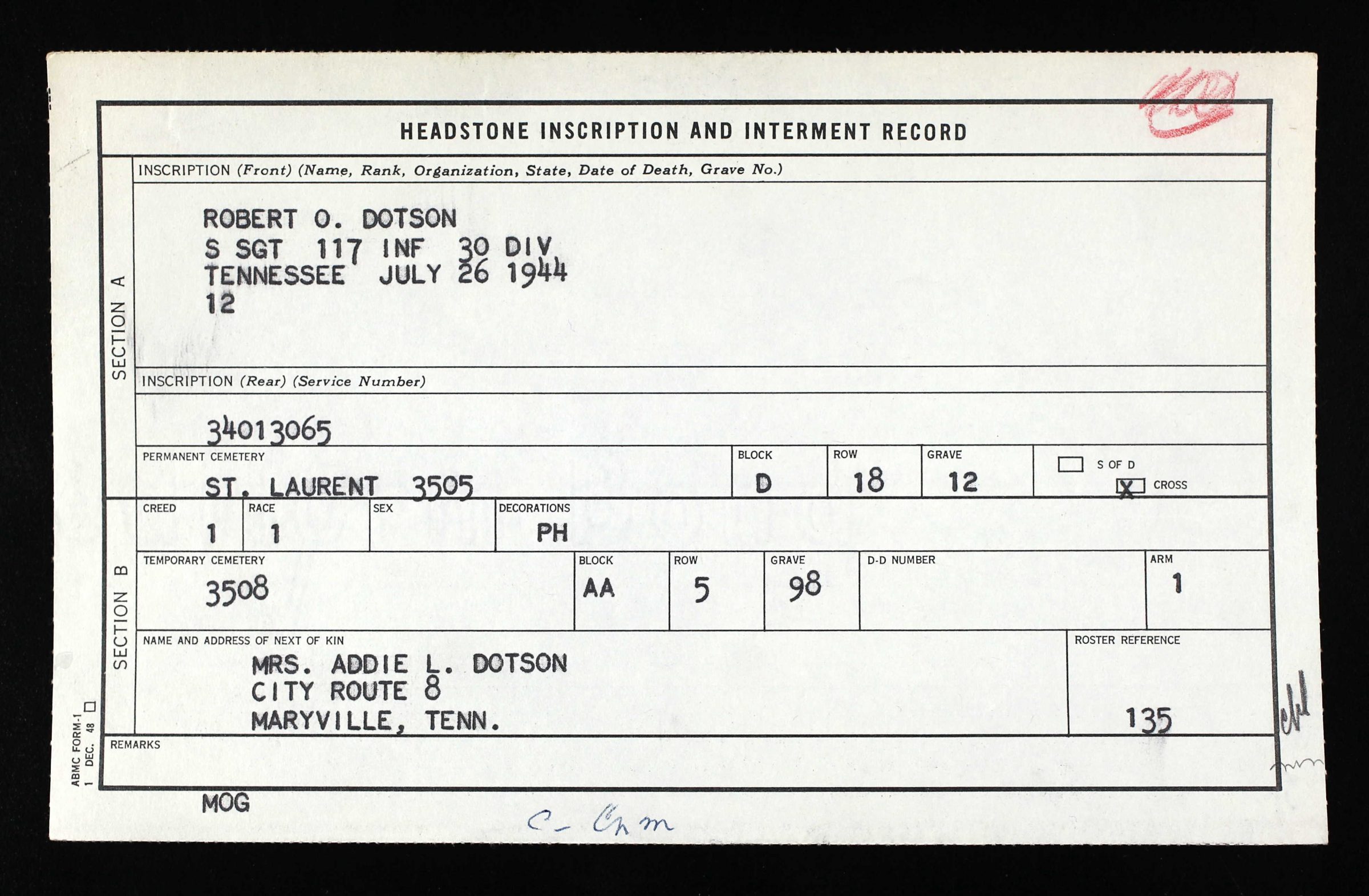
Staff Sergeant
U.S. Army, 117th Infantry Regiment, 30th Infantry Division
Died Wednesday, July 26, 1944
Buried at Normandy American Cemetery, Colleville-sur-Mer, France
Plot D Row 18 Grave 12
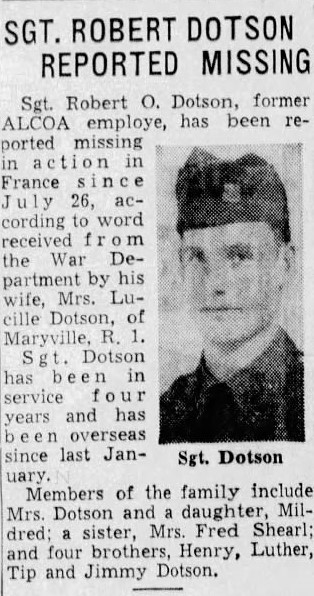
The Knoxville News-Sentinel, 20 August 1944
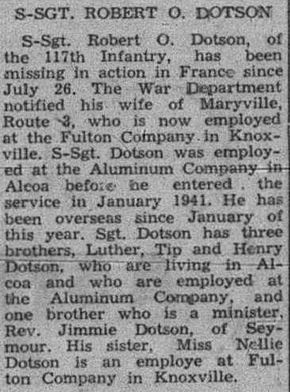
Sgt. Robert O. Dotson, former Alcoa employe, has been reported missing in action in France since July 26, according to word received from the War Department by his wife, Mrs. Lucille Dotson, of Maryville, R. 1. Sgt. Dotson has been in service four years and has been overseas since last January. Members of the family include Mrs. Dotson, and a daughter, Mildred; a sister, Mrs. Fred Shearl; and four brothers, Henry, Luther, Tip and Jimmy Dotson.
His widow’s obituary:
Addie Lucille Saffles, age 86, Maryville, passed away Wednesday, Sept. 23, 2009, at her home. She was a member of Broadway Baptist Church and was preceded in death by her first husband, Robert Oscar Dotson, who died during World War 11; and their first baby daughter, Norma Dotson; Harrison Frank Saffles…..
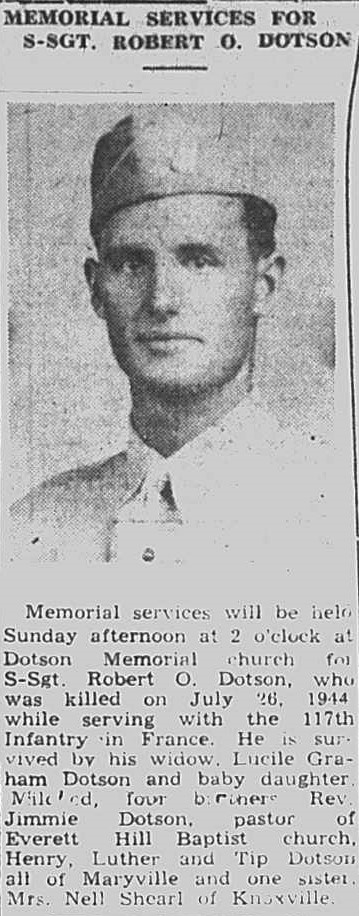
The Maryville and Alcoa Daily Times, August 31, 1945
Memorial services will be held Sunday afternoon at Dotson Memorial church for S-Sgt. Robert O. Dotson, who was killed on July 26, 1944, while serving with the 117th Infantry in France. He is survived by his wife, Lucile Graham Dotson and baby daughter Mildred, four brothers, Rev. Jimmie Dotson, pastor of Everett Hill Baptist church, Henry, Luther and Tip Dotson, all of Maryville, and one sister, Mrs. Nell Shearl of Knoxville.
The Breakout of Saint-Lô
By July 24, we had finally reached the outskirts of Saint-Lô and stood ready to help liberate the city in what would become known as the Breakout of Saint-Lô, a major turning point in the war in Europe.
The morning of July 25, the sky was filled with airplanes. I later read that was the largest amount of planes in the air up until that time, over Saint-Lô. The sky clouded up, though, and the attack was postponed. The planes were called back. But there had been a mistake in the planning, and those planes bombed American troops on their way back.
We could see the bombs dropping, like eggs out of hens’ nests, and they looked like they would come right down on us, but they didn’t quite. Mostly they landed behind us. None of them hit us, but we saw a lot of men falling behind us and some in front. It was terrible. Somebody even set off a smoke signal to warn the planes that they were dropping bombs in the wrong place, but some of the planes thought it was a signal to drop bombs there, so they kept on bombing. Our own planes wiped out a tank battalion that was over on our right. In fact, I saw the famous General McNair, who was there on an observation visit, get killed.
Later we found out six hundred Americans had been killed in that friendly fire incident.
But there was nothing to do but try again the next day, July 26. Again, the sky was filled with airplanes, but this time the attack went according to plan.
The 117th wasn’t ordered to go into Saint-Lô; we were supposed to fight around the edge of the city and take the high ground above it. The idea had been to use that huge aerial assault to daze the Germans and make it easier for ground troops to rush through and kill or capture them, and it had worked. We’d move fast until we found a pocket of Germans, and sometimes they’d fight, but not for long. We had the speed and the advantage, and they knew it. They’d give up and we’d capture them.
At one point I was talking to the company commander on the radio, and he wanted our platoon to try to go up a hill that another platoon had tried to go up and couldn’t. A lot of them had been killed, and we’d seen it happen. I said, “Well, how do you think we can if another can’t?” Sure enough, when I called for my men to go up that hill, they wouldn’t. And the squad leader, Sergeant Dotson, said to me, “Well, I don’t blame ’em much, really.”
But I knew we had to go where we’d been ordered to go. So I took off up the hill, figuring they would follow me. Turned out only Sergeant Dotson did, at first. And when we were about fifty yards up the hill, he was shot and killed.
Sergeant Dotson was the kind of man his troops really liked and admired—I did too—and as soon as the men saw that, they rushed up behind me and we started walking up that hill in a line, firing for all we were worth. Later the company commander would say he heard us firing as we went up and said to the fellow next to him, “Hell, everything just broke loose. Sounds like a war going on!” And somehow we got to the top without losing anyone else. By the time we got to the top, there were only three Germans up there still, and we took them captive.
We had a runner in our platoon who could speak a little German, and we tried to interrogate them as much as we could before we sent them back as prisoners of war. I’d told the men, “If these Germans make one move, shoot ‘em,” and I don’t know if those Germans spoke any English, but I’m sure they could tell by the looks on our faces how we were feeling. So they were absolutely scared, and we didn’t get much out of them.
Then this boy named Freeman, who’d been in Dotson’s squad, volunteered to take the captured Germans back, and I agreed. He marched them off, but about ten minutes later he was back, and he told me he’d shot them all. I asked him what for, and he said, “They tried to escape.” And that’s all he would ever say about it.
You’d think, hearing that story, that Freeman was some real toughie in thought, but he was a good-hearted boy. But you know, they’d killed his sergeant, buddy, and that was every bit of it.
By the night of the 26th, we’d taken that high ground. At daybreak we could see some of the town, just along the north side; there were a few buildings standing, but mostly the town had been all torn up. As we moved on that day—there was no time to rest; we had to march eight miles south to La Gonnivière by nightfall—we passed crater after crater after crater. Everything still standing was covered with dirt from the bomb blasts. There were fallen trees across the roads, dead animals everywhere, and of course, dead soldiers.
We did find one German alive, three full days after that first day’s bombing. He was buried in dirt; we wouldn’t have known he was there except that he was able to make a little noise. We dug him out, and he’d been cramped up so long, packed in the dirt with his feet under him, that he couldn’t straighten his legs out. At first when he couldn’t stand up we thought his legs were broken, but they were just locked stiff after three days buried in that dirt. – Memoir of Acie Durell Milner
- Rank: Staff Sergeant
- Date of birth: 5 August 1914
- Date of death: 26 July 1944
- County: Monroe
- Service Branch: Army/Army Air Forces
- Division/Assignment: 117th Infantry Regiment, 30th Infantry Division
- Theater: Europe
- Conflict: World War II
- Battles: Normandy Campaign
- Awards: Purple Heart
- Burial/Memorial Location: Normandy American Cemetery, Colleville-sur-Mer, France
- Location In Memorial: Pillar XVI, Top Panel
- Contact us to sponsor Robert O. Dotson
Image Gallery
Click a thumbnail below to view at full size.