
The story behind Knoxville’s East Tennessee Veterans Memorial began in Normandy, France

Bill Felton’s 1990 trip to the Normandy American Cemetery and Memorial in France deeply moved him, the Knoxville News Sentinel reported in 2002. “His visit was so powerful, it instilled in him a determination to come back home and create a memorial honoring fallen veterans of East Tennessee,” the article states.

Felton died in 2011, according to the East Tennessee Veterans Memorial Association website, but he left behind a permanent legacy for Knoxville – and one that’s celebrated by the entire region.

Here’s a look at how the East Tennessee Veterans Memorial came to be established where it now stands at World’s Fair Park.

East Tennessee Veterans Memorial beginnings: ‘It was a labor of love’

Once Felton began taking the first steps on his project, there was no shortage of supporters. Retired News Sentinel senior writer Fred Brown and John Romeiser, at the time a professor at the University of Tennessee, joined Felton on the project, Romeiser told Knox News. Romeiser was previously the association’s board president, and now serves as its historian.

“We had a great discussion. We talked about forming a committee, an organization that would do research. We brought on veterans from World War II and more recent Vietnam – more recent then,” Romeiser said. “It just grew exponentially.”

“It was a labor of love for Bill Felton,” Romeiser added. “He just had that dream. …He was driven. Very good guy, big heart. I learned a lot from him.”

“We want all of the community to be a part of this,” Felton told the News Sentinel in 2003. As it turned out, that was very much the case. Several mayors, state and federal senators expressed support for the memorial, Romeiser said.

It took a few tries to get a final plan for the memorial in place. Initially, it was envisioned to go by the doughboy statue in front of the former Knoxville High School, the News Sentinel reported in 2002. Another proposal suggested a small park on Gay Street, according to Romeiser. The memorial’s eventual location was finalized in January 2006 when the city announced it was donating a portion of World’s Fair Park for the project.

Felton’s inspiration becomes a reality

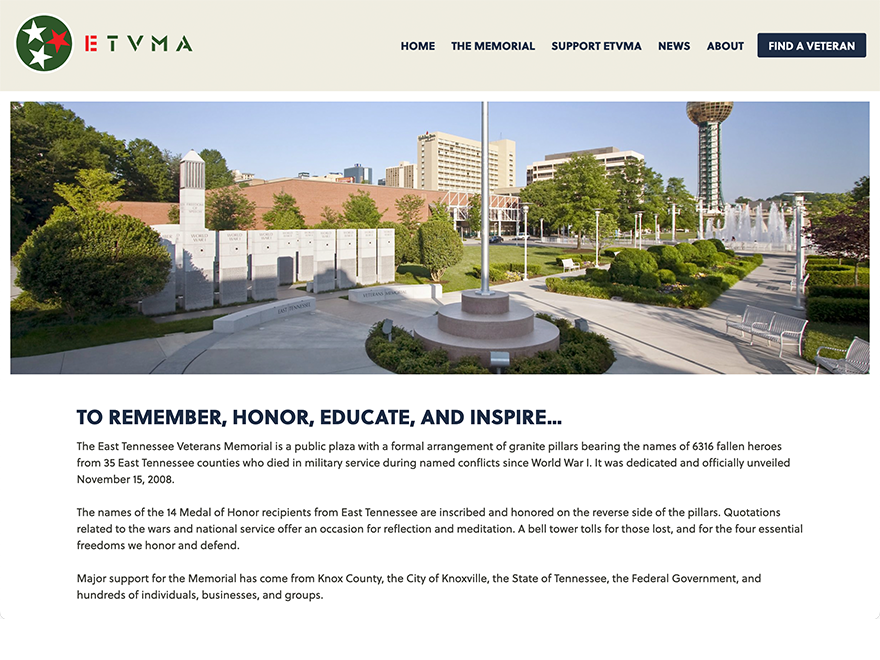
The memorial, comprised of 32 granite monuments, a flag and bell tower, was constructed between the World’s Fair Park playground and the historic L&N station. Each granite slab displays about 220 names of East Tennesseans who died in military service since the beginning of World War I, according to the website.

Early on, Romeiser helped research the names listed on the memorial alongside Cynthia Tinker, who worked for the University of Tennessee’s Center for the Study of War and Society. “We were building this database. We had about 3000 names initially, and now we have over 6,000,” Romeiser said. “We’re still finding names.”

The memorial was dedicated on Nov. 15, 2008. “We had a lot of veterans there, of course. We had different people in uniform. Huge crowd, lot of dignitaries. It was remarkable,” Romeiser recalled.

The East Tennessee Veterans Memorial will hold its annual reading of the names event this Memorial Day, Monday, May 27, at 6 a.m. at the memorial.

Hayden Dunbar is the storyteller reporter. Email hayden.dunbar@knoxnews.com.

Support strong local journalism by subscribing at knoxnews.com/subscribe.
The influenza pandemic of 1918-1920

Both on the home front and in the combat zones of 1918, the greatest single killer of the Great War was not artillery, machine guns, or poison gas: it was far more insidious and invisible.  By some estimates, half of the doughboys, Marines and sailors who died in Europe fell not to enemy fire but to the influenza pandemic of 1918-1920.  Sometimes referred to as the Spanish flu, the “plague of the Spanish lady,” and the “grippe,” the epidemic disappeared as quickly as it had appeared by the time the Armistice was signed in November 1918.

On March 11, 1918 the first cases of what would become the influenza pandemic were reported in the U.S. when 107 soldiers rapidly became ill at the Camp Funston training camp in Fort Riley, Kansas.  It was the worst pandemic in modern history. The flu that year killed only 2.5 percent of its victims, but more than a fifth of the world’s entire population caught it; it is estimated that between fifty million and one hundred million people died in just a few months. Historians believe at least 500,000 died in the United States alone.

The influenza outbreak swept through military bases in the United States.  The virus was an exceptionally deadly strain that struck young, previously healthy adults particularly hard. Once their bodies were weakened, many were vulnerable to secondary infections such as pneumonia, often leading to death. By the late spring, there were influenza outbreaks in fourteen of the largest Army training camps in the United States. After temporarily subsiding, a second more deadly wave of influenza appeared in late summer 1918. By mid-September, it had developed into a mass outbreak. Many servicemen caught the influenza virus in the United States and boarded troopships bound for Europe, unaware of their infected condition. Crowded quarters on the ships provided an ideal environment that readily enabled the flu to spread. Some soldiers did not survive the two-week voyage. Others fell sick during the crossing and were taken directly to hospitals in Britain and France when their vessels entered port.

Healthy soldiers arriving in France in late 1917 and in early 1918 immediately went into battle, distinguishing themselves in infantry charges, artillery exchanges, and trench warfare.  However, if they were not already infected by the virus, many contracted it in the close quarters in which they were confined.  As has been pointed out, others contracted the disease onboard ship before even arriving in England or France.  A third group became ill so quickly in the U.S. that they never had time to go overseas.  They died in the field hospitals of their training camps.  Others were buried at sea before even reaching land.

A Sampling, by County, of East Tennesseans Who Succumbed to the Flu Outbreak

Leonard F. Marine, Blount

Hobart D. Willocks, Blount

Charles S. Lacey, Carter

Cecil C. Broyles, Greene

Vestus Kesterson, Greene

Charles D. Johnston Jr, Knox

Arl B. Kelly, Knox

Grant Vandeventer, Knox

Arthur N. Bacon, McMinn

Lacy O. Smith, Marion

Jasper York, Scott

Benjamin J. Cogdill, Sevier

Joseph S. Bachman, Sullivan

Wesley M. Furches, Washington